
Cybersecurity area
Application Security
Application Security protects applications, APIs, code, open-source dependencies, and runtime environments from development through production.
Acronym Glossary
This glossary explains acronyms used in this part so the intended security function is clear.
- API
- Application Programming InterfaceAn interface through which applications, services, or partners access functionality and data.
- SAST
- Static Application Security TestingStatic testing of source code or binaries without running the application.
- DAST
- Dynamic Application Security TestingDynamic testing of a running application from the outside, similar to attacker behavior.
- SCA
- Software Composition AnalysisAssessment of open-source libraries, dependencies, vulnerabilities, and license risks.
- RASP
- Runtime Application Self-ProtectionProtection inside the running application by observing inputs, calls, and production behavior.
- WAF
- Web Application FirewallAn application firewall protecting web applications and APIs from application-layer attacks.
What This Area Covers
Application Security covers applications from design through development, testing, deployment, and runtime protection. It includes custom code, open-source components, APIs, web applications, mobile applications, containers, CI/CD pipelines, and integration layers.
Why It Matters
Applications are often the direct interface between the organization and customers, partners, or internal processes. A vulnerability can lead to data leakage, account takeover, transaction manipulation, or compromise of backend systems. SAST, DAST, SCA, RASP, API security, WAF, bot protection, and client-side protection should therefore be distinguished by lifecycle phase, risk type, and remediation path.
How To Navigate This Area
Application security is effective when code testing, dependency control, dynamic testing, API protection, runtime detection, WAF, bot protection, and client-side protection work together. Current priorities also include software supply chain security, DevSecOps, containers, cloud-native applications, automated abuse of web services, and vulnerabilities introduced by fast development or AI-assisted code.
Technology selection depends on whether the organization wants to improve the development process, test running applications, control dependencies, protect production runtime, gain control over APIs, or defend web applications against automated abuse and browser-side risks. The best results appear when tools connect to pipelines, ticketing, security operations, and prioritization by real impact on applications, data, and users.
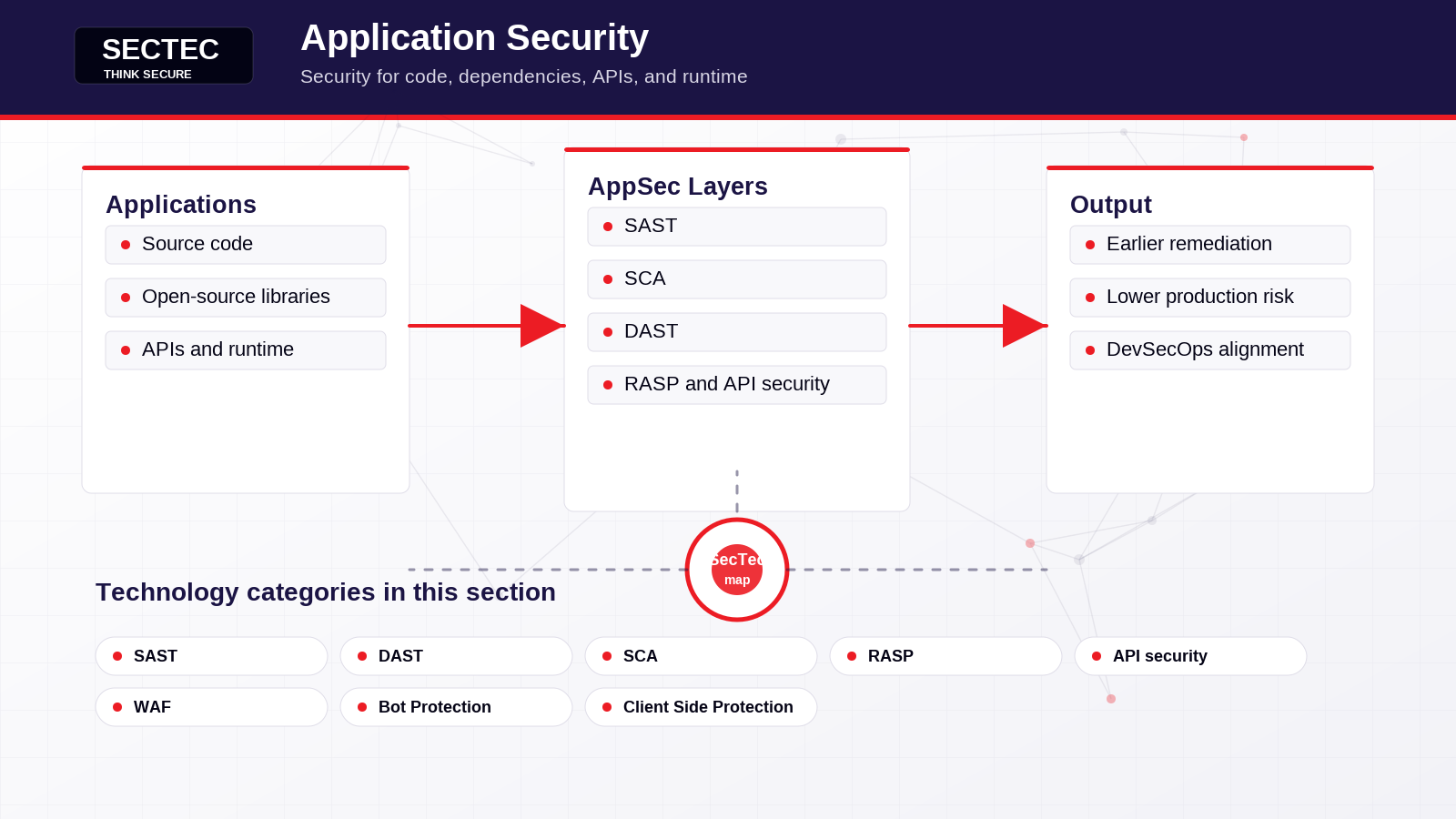
The technology list below works as a map of the Application Security area. The practical sequence is to name the security problem first, select the closest technology category second, and only then compare relevant vendors. This helps separate similar-sounding solutions and reduces the risk of adding another tool without a clear architectural role.
Technical Section Schema
Questions To Ask When Selecting A Solution
- Are applications developed internally, externally, or in a mixed model?
- Is it necessary to inspect source code, runtime behavior, open-source components, or APIs?
- How are the software supply chain, libraries, and third-party vulnerabilities managed?
- How will findings be triaged, assigned to developers, and fixed?
- Should the solution support DevSecOps, existing CI/CD tools, WAF policy, bot protection, or client-side attack protection?
How To Use This Section
Each technology page expands one category, explains its architectural role, and lists SecTec portfolio vendors related to that area. The section page is therefore the orientation layer, while the detail pages support concrete mapping to solutions.
Vendors From The SecTec Portfolio
Attack coverage and defensive context
MITRE ATT&CK® Enterprise version 19.1 is used as a reference model. The mapping is a SecTec expert interpretation and does not imply endorsement by MITRE.
Practical attack scenarios
- Phishing and identity abuseAn adversary manipulates a user, obtains credentials, or abuses a trusted account to gain access to the environment.
- Public application or API abuseAn adversary exploits a vulnerable web application, API, client-side code, or software component for initial access and execution.
- Cloud and SaaS compromiseAn adversary abuses cloud identities, permissions, configurations, or application integrations to access services and data.
- Malware and Command and ControlMalicious code executes, maintains access, and communicates with adversary infrastructure through common or covert channels.
- Data exfiltration and leakageAn adversary searches for, collects, and transfers sensitive data from endpoints, cloud services, email, or internal repositories.
- Supply chain and trusted accessAn adversary abuses a supplier, software dependency, external access path, or trusted relationship to bypass normal controls.
- Business Email Compromise and mailbox takeoverAn adversary takes over or impersonates a trusted email identity and abuses communications for fraud, payment diversion, data collection, or further phishing.
- Privilege escalation and persistenceAn adversary expands privileges, creates or modifies accounts and policies, and establishes repeatable access to systems, identities, or cloud environments.
- Insider threat and authorized access abuseAn insider or an adversary with a valid account abuses legitimate permissions to discover, copy, manipulate, or transfer sensitive data.
- BOLA – Broken Object Level AuthorizationAn adversary changes an object identifier in an API request and gains access to data or operations belonging to another user, account, or tenant.
- BOPLA – Broken Object Property Level AuthorizationAn API exposes or allows modification of sensitive object properties that the user should not access, including excessive data exposure and mass assignment.
- BFLA – Broken Function Level AuthorizationA regular or unauthenticated user invokes an administrative or privileged API function that should not be available to them.
- Broken API authentication and token abuseAn adversary bypasses login, password recovery, or token validation and assumes the identity of a user or service.
- Sensitive business flow and bot abuseAn automated adversary abuses legitimate functionality such as purchasing, booking, registration, voting, commenting, or account recovery.
- SSRF – Server-Side Request ForgeryAn adversary causes a server or API to fetch an attacker-controlled address and reaches internal services, cloud metadata, or protected network targets.
- API security misconfiguration and exposed interfacesInsecure defaults, debug endpoints, broken CORS, verbose errors, or missing security headers expose data and functionality to an adversary.
- Shadow and zombie APIs without managed inventoryUnknown, forgotten, or outdated API versions remain reachable without current controls, ownership, documentation, and monitoring.
- Unsafe consumption of third-party APIsAn application trusts data or redirects from a partner API more than ordinary input and propagates a supplier compromise into its own environment.
- Credential stuffing and password sprayingAn adversary automatically tests leaked username-password pairs or a small set of common passwords against many accounts.
- Session and access-token hijackingAn adversary steals a cookie, OAuth token, or another session artifact and accesses a service without re-entering a password or MFA.
- Injection and command executionUntrusted input changes the meaning of a command, query, or template and enables data access, logic bypass, or code execution.
- Path traversal and file inclusionAn adversary manipulates a file path or imported name and reads, writes, or executes content outside the permitted directory.
- Malicious file upload and unsafe deserializationAn application accepts or processes a malicious file or serialized object and enables code execution, control bypass, or compromise of other users.
- Client-side injection and Cross-Site ScriptingAn adversary injects untrusted content into a user's browser and executes script in the context of a trusted application.
Relevant ATT&CK techniques
- T1059 · Command and Scripting InterpreterDetect, Prevent, Respond, Validate
- T1078 · Valid AccountsDetect, Prevent, Respond
- T1189 · Drive-by CompromiseDetect, Prevent, Respond, Validate
- T1190 · Exploit Public-Facing ApplicationDetect, Prevent, Respond, Validate
- T1195 · Supply Chain CompromisePrevent, Validate
- T1567 · Exfiltration Over Web ServiceDetect, Prevent, Respond